

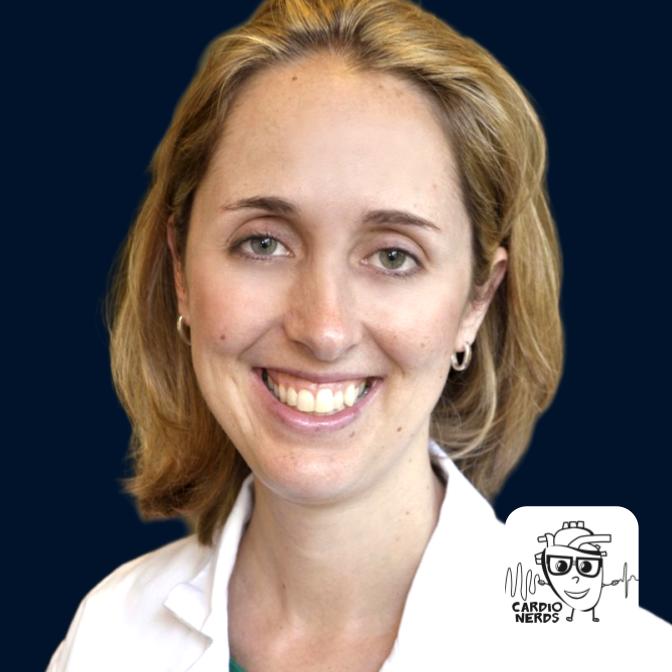
Dr. Grace Qiu is an internal medicine resident at University of Pennsylvania in Philadelphia.
Podcasts
 CathMasters # 15Sep 22, 2026
ACS Guidelines Question #6

This episode is part of our comprehensive Decipher the Guidelines Series covering the 2025 ACC/AHA/ACEP/NAEMSP/SCAI Guideline for the Management of Patients With Acute Coronary Syndromes. The following question refers to Section 4.4 of the 2025 ACS Guidelines. The question is asked by Thomas Jefferson medical student and CardioNerds Academy Intern Dr. Grace Qiu, answered first by University of Miami cardiology fellow and member of the CardioNerds Interventional Cardiology Council Dr. Saahil Jumkhawala, and then by expert faculty Dr. Binita Shah. Dr. Binita Shah is an associate professor of medicine, interventional cardiologist, Director for research in Interventional Cardiology, and Director of the Department of Medicine Clinical Investigator Track at NYU. She is also an associate director of interventional cardiology and director of the transcatheter valve program at the VA New York Harbor Healthcare System. She was a member of the 2025 ACS Guidelines writing committee.
9m CardioNerds # 467Sep 22, 2026
ACS Guidelines Question #6
This episode is part of our comprehensive Decipher the Guidelines Series covering the 2025 ACC/AHA/ACEP/NAEMSP/SCAI Guideline for the Management of Patients With Acute Coronary Syndromes. The following question refers to Section 4.4 of the 2025 ACS Guidelines. The question is asked by Thomas Jefferson medical student and CardioNerds Academy Intern Dr. Grace Qiu, answered first by University of Miami cardiology fellow and member of the CardioNerds Interventional Cardiology Council Dr. Saahil Jumkhawala, and then by expert faculty Dr. Binita Shah. Dr. Binita Shah is an associate professor of medicine, interventional cardiologist, Director for research in Interventional Cardiology, and Director of the Department of Medicine Clinical Investigator Track at NYU. She is also an associate director of interventional cardiology and director of the transcatheter valve program at the VA New York Harbor Healthcare System. She was a member of the 2025 ACS Guidelines writing committee.
9m- CardioNerds # 466Sep 18, 2026
ACS Guidelines Question #5

This episode is part of our comprehensive Decipher the Guidelines Series covering the 2025 ACC/AHA/ACEP/NAEMSP/SCAI Guideline for the Management of Patients With Acute Coronary Syndromes. The following question refers to Section 4.3 of the 2025 ACS Guidelines. The question is asked by Thomas Jefferson medical student and CardioNerds Academy Intern Dr. Grace Qiu, answered first by Cleveland Clinic interventional and structural cardiology fellow and member of the CardioNerds Interventional Cardiology Council Dr. Eunice Dugan, and then by expert faculty Dr. Binita Shah. Dr. Binita Shah is an associate professor of medicine, interventional cardiologist, Director for research in Interventional Cardiology, and Director of the Department of Medicine Clinical Investigator Track at NYU. She is also an associate director of interventional cardiology and director of the transcatheter valve program at the VA New York Harbor Healthcare System. She was a member of the 2025 ACS Guidelines writing committee.
13m - CathMasters # 14Sep 18, 2026
ACS Guidelines Question #5
This episode is part of our comprehensive Decipher the Guidelines Series covering the 2025 ACC/AHA/ACEP/NAEMSP/SCAI Guideline for the Management of Patients With Acute Coronary Syndromes. The following question refers to Section 4.3 of the 2025 ACS Guidelines. The question is asked by Thomas Jefferson medical student and CardioNerds Academy Intern Dr. Grace Qiu, answered first by Cleveland Clinic interventional and structural cardiology fellow and member of the CardioNerds Interventional Cardiology Council Dr. Eunice Dugan, and then by expert faculty Dr. Binita Shah. Dr. Binita Shah is an associate professor of medicine, interventional cardiologist, Director for research in Interventional Cardiology, and Director of the Department of Medicine Clinical Investigator Track at NYU. She is also an associate director of interventional cardiology and director of the transcatheter valve program at the VA New York Harbor Healthcare System. She was a member of the 2025 ACS Guidelines writing committee.
13m - CardioNerds # 465Sep 17, 2026
ACS Guidelines Question #4
This episode is part of our comprehensive Decipher the Guidelines Series covering the 2025 ACC/AHA/ACEP/NAEMSP/SCAI Guideline for the Management of Patients With Acute Coronary Syndromes. The following question refers to Sections 4.3.2 and 4.4 of the 2025 ACS Guidelines. The question is asked by Thomas Jefferson medical student and CardioNerds Academy Intern Dr. Grace Qiu, answered first by University of Miami cardiology fellow and member of the CardioNerds Interventional Cardiology Council Dr. Saahil Jumkhawala, and then by expert faculty Dr. Binita Shah. Dr. Binita Shah is an associate professor of medicine, interventional cardiologist, Director for research in Interventional Cardiology, and Director of the Department of Medicine Clinical Investigator Track at NYU. She is also an associate director of interventional cardiology and director of the transcatheter valve program at the VA New York Harbor Healthcare System. She was a member of the 2025 ACS Guidelines writing committee.
10m - CathMasters # 13Sep 17, 2026
ACS Guidelines Question #4
This episode is part of our comprehensive Decipher the Guidelines Series covering the 2025 ACC/AHA/ACEP/NAEMSP/SCAI Guideline for the Management of Patients With Acute Coronary Syndromes. The following question refers to Sections 4.3.2 and 4.4 of the 2025 ACS Guidelines. The question is asked by Thomas Jefferson medical student and CardioNerds Academy Intern Dr. Grace Qiu, answered first by University of Miami cardiology fellow and member of the CardioNerds Interventional Cardiology Council Dr. Saahil Jumkhawala, and then by expert faculty Dr. Binita Shah. Dr. Binita Shah is an associate professor of medicine, interventional cardiologist, Director for research in Interventional Cardiology, and Director of the Department of Medicine Clinical Investigator Track at NYU. She is also an associate director of interventional cardiology and director of the transcatheter valve program at the VA New York Harbor Healthcare System. She was a member of the 2025 ACS Guidelines writing committee.
10m - CardioNerds # 464Sep 16, 2026
ACS Guidelines Question #3
This episode is part of our comprehensive Decipher the Guidelines Series covering the 2025 ACC/AHA/ACEP/NAEMSP/SCAI Guideline for the Management of Patients With Acute Coronary Syndromes. The following question refers to Section 3.2 of the 2025 ACS Guidelines. The question is asked by Thomas Jefferson medical student and CardioNerds Academy Intern Dr. Grace Qiu, answered first by Cleveland Clinic interventional and structural cardiology fellow and member of the CardioNerds Interventional Cardiology Council Dr. Eunice Dugan, and then by expert faculty Dr. Binita Shah. Dr. Binita Shah is an associate professor of medicine, interventional cardiologist, Director for research in Interventional Cardiology, and Director of the Department of Medicine Clinical Investigator Track at NYU. She is also an associate director of interventional cardiology and director of the transcatheter valve program at the VA New York Harbor Healthcare System. She was a member of the 2025 ACS Guidelines writing committee.
10m - CathMasters # 12Sep 16, 2026
ACS Guidelines Question #3
This episode is part of our comprehensive Decipher the Guidelines Series covering the 2025 ACC/AHA/ACEP/NAEMSP/SCAI Guideline for the Management of Patients With Acute Coronary Syndromes. The following question refers to Section 3.2 of the 2025 ACS Guidelines. The question is asked by Thomas Jefferson medical student and CardioNerds Academy Intern Dr. Grace Qiu, answered first by Cleveland Clinic interventional and structural cardiology fellow and member of the CardioNerds Interventional Cardiology Council Dr. Eunice Dugan, and then by expert faculty Dr. Binita Shah. Dr. Binita Shah is an associate professor of medicine, interventional cardiologist, Director for research in Interventional Cardiology, and Director of the Department of Medicine Clinical Investigator Track at NYU. She is also an associate director of interventional cardiology and director of the transcatheter valve program at the VA New York Harbor Healthcare System. She was a member of the 2025 ACS Guidelines writing committee.
10m - CathMasters # 7Jul 3, 2026
ACS Guidelines Question #2
The following question refers to Section 5.2.1 of the 2025 ACS Guidelines. A 63-year-old woman presented to the emergency room for chest pain. She described having exertional chest pain for the past two months and had an episode of severe pain after dinner 3 days ago. She went to bed and slept it off. She told her children today at a family gathering, and was immediately brought to the ED by her daughter. She has a history of hypertension and hyperlipidemia. She was asymptomatic and normotensive in the ED. Labs show a down-trending troponin and an elevated NT-proBNP but are otherwise unremarkable. Her ECG showed Q waves with ST elevation in V2-V4. She was treated with aspirin and heparin drip, and taken to the cath lab. Coronary angiogram showed complete proximal LAD occlusion with right-to-left collaterals, without significant residual disease elsewhere. She remains asymptomatic and is stable, both hemodynamically and electrically. What is the next best step with regard to reperfusion and anti-thrombotic management? This episode is part of our comprehensive Decipher the Guidelines Series covering the 2025 ACC/AHA/ACEP/NAEMSP/SCAI Guideline for the Management of Patients With Acute Coronary Syndromes.
10m - CardioNerds # 456Jun 25, 2026
ACS Guidelines Question #2
The following question refers to Section 5.2.1 of the 2025 ACS Guidelines. A 63-year-old woman presented to the emergency room for chest pain. She described having exertional chest pain for the past two months and had an episode of severe pain after dinner 3 days ago. She went to bed and slept it off. She told her children today at a family gathering, and was immediately brought to the ED by her daughter. She has a history of hypertension and hyperlipidemia. She was asymptomatic and normotensive in the ED. Labs show a down-trending troponin and an elevated NT-proBNP but are otherwise unremarkable. Her ECG showed Q waves with ST elevation in V2-V4. She was treated with aspirin and heparin drip, and taken to the cath lab. Coronary angiogram showed complete proximal LAD occlusion with right-to-left collaterals, without significant residual disease elsewhere. She remains asymptomatic and is stable, both hemodynamically and electrically. What is the next best step with regard to reperfusion and anti-thrombotic management? This episode is part of our comprehensive Decipher the Guidelines Series covering the 2025 ACC/AHA/ACEP/NAEMSP/SCAI Guideline for the Management of Patients With Acute Coronary Syndromes.
10m - CathMasters # 5Jun 25, 2026
ACS Guidelines Question #1

The following question refers to Section 7.1 of the 2025 ACS Guidelines. A 68-year-old man with a history of hypertension, hyperlipidemia, stage III chronic kidney disease, and prior tobacco use presents to a local emergency department with reports of chest pain while raking leaves at home. Upon arrival, he is hemodynamically stable with a heart rate of 86 beats per minute and a blood pressure of 133/85 mmHg. His EKG reveals ST elevations in the septal and anterior leads (V1-V4). He is given 324mg of aspirin and is promptly evaluated by the interventional cardiology team, who elects to take him emergently to the catheterization lab. Upon arrival to the catheterization lab, the nurse asks the interventional fellow which access sites they should prep for this case? How should the interventional fellow respond? This episode is part of our comprehensive Decipher the Guidelines Series covering the 2025 ACC/AHA/ACEP/NAEMSP/SCAI Guideline for the Management of Patients With Acute Coronary Syndromes.
9m - CardioNerds # 453Jun 4, 2026
ACS Guidelines Question #1
The following question refers to Section 7.1 of the 2025 ACS Guidelines. A 68-year-old man with a history of hypertension, hyperlipidemia, stage III chronic kidney disease, and prior tobacco use presents to a local emergency department with reports of chest pain while raking leaves at home. Upon arrival, he is hemodynamically stable with a heart rate of 86 beats per minute and a blood pressure of 133/85 mmHg. His EKG reveals ST elevations in the septal and anterior leads (V1-V4). He is given 324mg of aspirin and is promptly evaluated by the interventional cardiology team, who elects to take him emergently to the catheterization lab. Upon arrival to the catheterization lab, the nurse asks the interventional fellow which access sites they should prep for this case? How should the interventional fellow respond? This episode is part of our comprehensive Decipher the Guidelines Series covering the 2025 ACC/AHA/ACEP/NAEMSP/SCAI Guideline for the Management of Patients With Acute Coronary Syndromes.
10m