



Episode # 3 • 17 Jan 2025
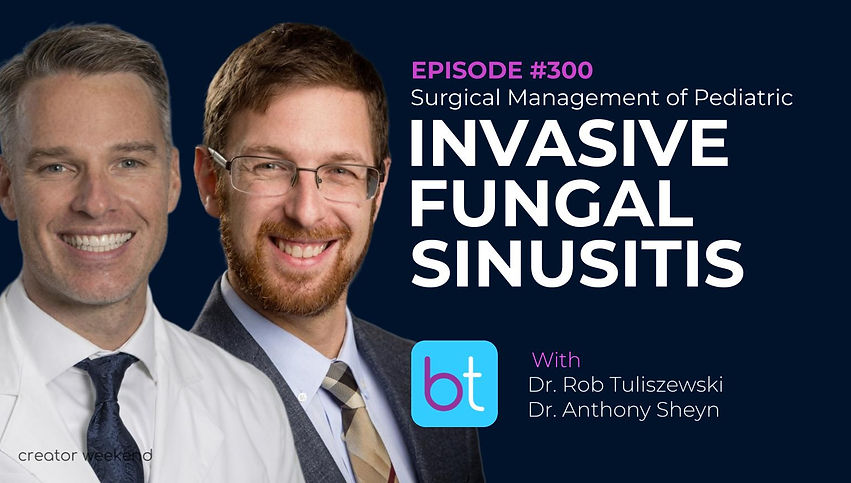
Surgical Management of Pediatric Invasive Fungal Sinusitis
What once meant a 3:00 AM trip to the operating room is now a planned daytime case: with antifungal pretreatment and a standardized protocol, one pediatric team in Memphis estimates survival of about 94 percent over 15 years for children with cancer and invasive fungal sinusitis (IFS), compared with published mortality estimates ranging from 20 to 80 percent. On this episode of the BackTable Creator Weekend™ series on pediatric head and neck cancer, host Dr. Javan Nation welcomes Dr. Rob Tuliszewski and Dr. Anthony Sheyn, pediatric otolaryngologists at Le Bonheur Children's Hospital and St. Jude Children's Research Hospital, to walk through the surgical management of invasive fungal sinusitis in children with cancer. They discuss pretransplant ENT screening, the inpatient consult, what early disease looks like on endoscopy, how antifungal pretreatment changes the urgency of surgery, and how they approach debridement in the operating room.
Timestamps
00:00 - Introduction
02:05 - Pretransplant ENT Screening and the Initial Consult
07:45 - Bedside Endoscopy and Early Endoscopic Findings
11:20 - Role of CT and High-Risk Patients
13:46 - Biopsy Strategy and Frozen Sections
17:40 - Margins, Neutrophil Counts, and Returning to the OR
19:52 - Consent, Family Counseling, and Surgical Boundaries
23:21 - Second-Look Surgery and Margin-First Resection
26:16 - Bleeding Control in Thrombocytopenic Children
29:02 - Involved Bone and Postoperative Surveillance
33:25 - Standardizing the Protocol
36:40 - Preoperative Labs and Platelet Thresholds
39:17 - Lessons Learned and Closing Remarks
Resources
You may also like
More about this episode
The conversation then moves into the operating room: where to biopsy, why healthy bleeding tissue is the surgical endpoint, and why the team relies on permanent pathology rather than frozen sections. Drs. Tuliszewski and Sheyn explain how a second margin and an absolute neutrophil count around 600 guide the decision to return to the operating room, how far to go toward the orbit and skull base, and why the prognosis of the underlying cancer shapes the extent of surgery. They share practical techniques for margin-first resection, bleeding control in thrombocytopenic children, and management of involved bone, and close on how a standardized protocol and constant team communication have made these consults a routine part of their practice, along with how they would adjust for children who have not been pretreated.
The Materials available on BackTable are provided for informational and educational purposes only and are not a substitute for the independent professional judgment of a qualified healthcare professional in diagnosing or treating patients. Any opinions, statements, or views expressed are those of the individual contributors and do not necessarily reflect those of the publisher, platform, or any affiliated organization.