

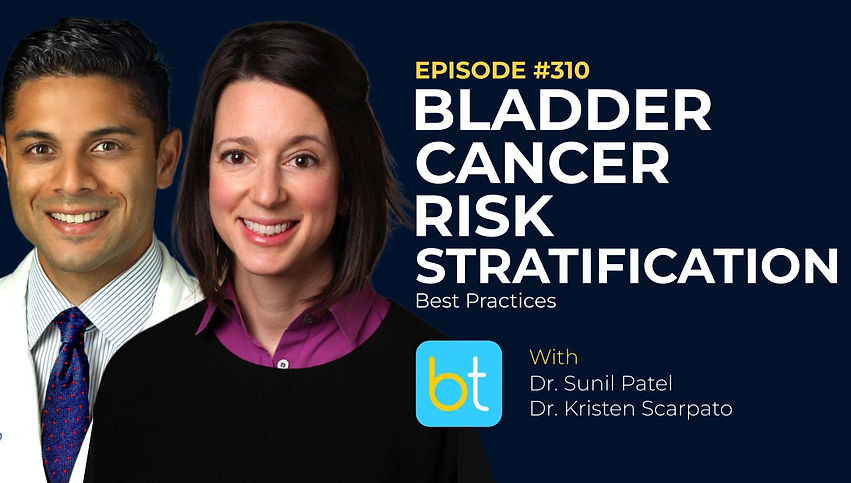

Episode # 310 • 18 Jun 2026
Bladder Cancer Risk Stratification: Best Practices
Why does up to 10% of bladder cancer pathology change on expert review, and what does that mean for your intermediate and high-risk patients? In this episode of BackTable, Dr. Bogdana Schmidt interviews urologists Dr. Kristen Scarpato and Dr. Sunil Patel to explore the complexities of diagnosis and risk assessment in non–muscle invasive bladder cancer (NMIBC). They discuss the real-world challenges of pathology interpretation, risk-group assignment, evolving diagnostic tools, and the impact these factors have on treatment decisions and patient outcomes.
This podcast is supported by an educational grant from Johnson & Johnson.
Timestamps
00:00 - Introduction
01:02 - Risk Stratification
07:22 - Upstaging to High Risk
10:06 - Calculators and Patient Education
15:22 - Specific Tests Use Cases
18:50 - Conflicting Biomarker Results
21:36 - Adjunct Tests and Counseling
24:03 - Recurrence After Chemo Next Steps
27:01 - Escalation Deescalation Balance
32:48 - Future Research Priorities
35:43 - Biology Based Risk Stratification
38:03 - Clinical Pearls and Wrap Up
Resources
You may also like
More about this episode
The conversation highlights the heterogeneity of intermediate-risk disease, the role and importance of expert pathology over-reads, and the need to accurately document the risk category for ongoing care. They discuss selective use of urinary and genomic assays and how these tests fit alongside cystoscopy and blue light endoscopy. Practical treatment approaches are reviewed, including when to use intravesical gemcitabine or BCG, managing care during BCG shortages, and balancing escalation versus de-escalation of therapy. Additional topics include strategies for long-term surveillance, upper tract imaging, rising rates of bladder cancer in younger patients, and why thorough TURBT and strong patient-provider communication remain central to optimal management.
The Materials available on BackTable are provided for informational and educational purposes only and are not a substitute for the independent professional judgment of a qualified healthcare professional in diagnosing or treating patients. Any opinions, statements, or views expressed are those of the individual contributors and do not necessarily reflect those of the publisher, platform, or any affiliated organization.